

The tango is one of the most elegant dances in the world. But it only works when both partners know the steps. The moment one person pulls in a direction the other hasn’t agreed to, the whole thing falls apart, and the grace of the dance is lost.
Signing a technology contract works the same way. On paper, it looks like a partnership between two organisations committing to a shared outcome. But the contract arrives written in one partner’s language, reflecting one partner’s standard risk position, and most buyers simply don’t have someone in the room who speaks it fluently. That is the reason for a translator.
Even two professional dancers, each exceptional in their own right, don’t simply walk onto the floor together for the first time and perform. There is always a choreographer, someone who understands both dancers and who ensures that when they move together, it is with clarity, confidence, and a shared understanding of every step. The performance only works because someone made sure both sides knew the routine before the music started.
In technology procurement, that is exactly what Tango does.
According to PMI’s Pulse of the Profession, Australia loses an estimated $139 million for every $1 billion invested in technology projects, the highest project waste rate of any country surveyed. That figure is driven by the gap between what was promised during the sales process and what was actually written into the contract, and the uncomfortable truth that most organisations never close that gap before they sign.
“We’re not there to fight the vendor. We’re there to make sure both sides actually understand what they’re agreeing to, because that’s when the relationship works best for everyone.” — Mark Birkinshaw, Tango
Why Most Contracts Start Unbalanced
Picture this. A software vendor sends you their standard contract. Your instinct, and theirs, is to treat it as a formality. Something to be signed so the real work can begin.
What you are actually holding is a document written primarily by lawyers for lawyers. It reflects the vendor’s standard risk position, shaped over many iterations, and it is not written with your specific operational context in mind. That is not cynicism about vendors; it is simply how standard contracts work. The vendor’s legal team writes to protect their client. Without specialist input on your side, there is no equivalent counterweight.
In most organisations, not-for-profits, and medium-sized businesses, there is no contract specialist in the room when the agreement arrives. The result is an imbalance that is rarely intentional but almost always disadvantages the buyer.
What compounds this is the gap between what happens during the sales process and what ends up in the legal agreement. A vendor’s sales team will describe what the software does at its best. The legal agreement, by contrast, is written conservatively, to manage risk and define limits. Without someone who understands both worlds bridging the gap, the customer can arrive at go-live expecting something the contract never actually guaranteed.
Three Documents. One Dance.
Successful IT procurement relies on three documents that must move in perfect synchrony. When they do, your interests are protected from selection to the last day of the engagement.
The RFP: The Opening Move
The Request for Proposal is where the vendor makes their pitch. They respond to your requirements, outline what they can do, and make commitments that sound compelling. It is the most optimistic document in the entire process and the most legally fragile. RFP responses are generally non-binding. A vendor’s written commitment during the tender phase carries no legal weight whatsoever unless it is explicitly transferred into the documents that follow. The opening move means nothing if it does not lead anywhere.
The Statement of Work: The Agreed Steps
The Statement of Work is where promises become real. It documents exactly what the supplier will deliver, by when, and to what standard. Think of it as the choreography, the written-down version of the routine both parties have agreed to perform. A well-drafted SOW prevents disputes before they start. A vague SOW, one that uses language like ‘reasonable endeavours’ or ‘subject to client availability’ without clear definitions, is an open invitation for the supplier to improvise in ways that do not serve you. At Tango, we compare every SOW against the original tender response line by line. Anything the vendor promised during the RFP that hasn’t made it into the SOW gets challenged before the contract is signed.
The Ts&Cs: The Rules of the Stage
The Terms and Conditions are the legal framework governing the entire relationship. Who is liable if things go wrong, what happens during a dispute, what obligations exist around your data, and what your options are if performance falls short. The most dangerous scenario in IT procurement is a well-negotiated SOW appended to a generic, vendor-drafted set of T&Cs. A supplier’s boilerplate contract may contain a force majeure clause so broadly worded that it allows them to miss every deadline in your SOW without consequence. These two documents must be read together and aligned.
Your Contract in Plain English: The RAG Framework
Tango’s contract review process categorises every clause using a Red, Amber, Green analysis. A traffic light for your agreement that tells you exactly where to act, where to pay attention, and where you can move forward with confidence.
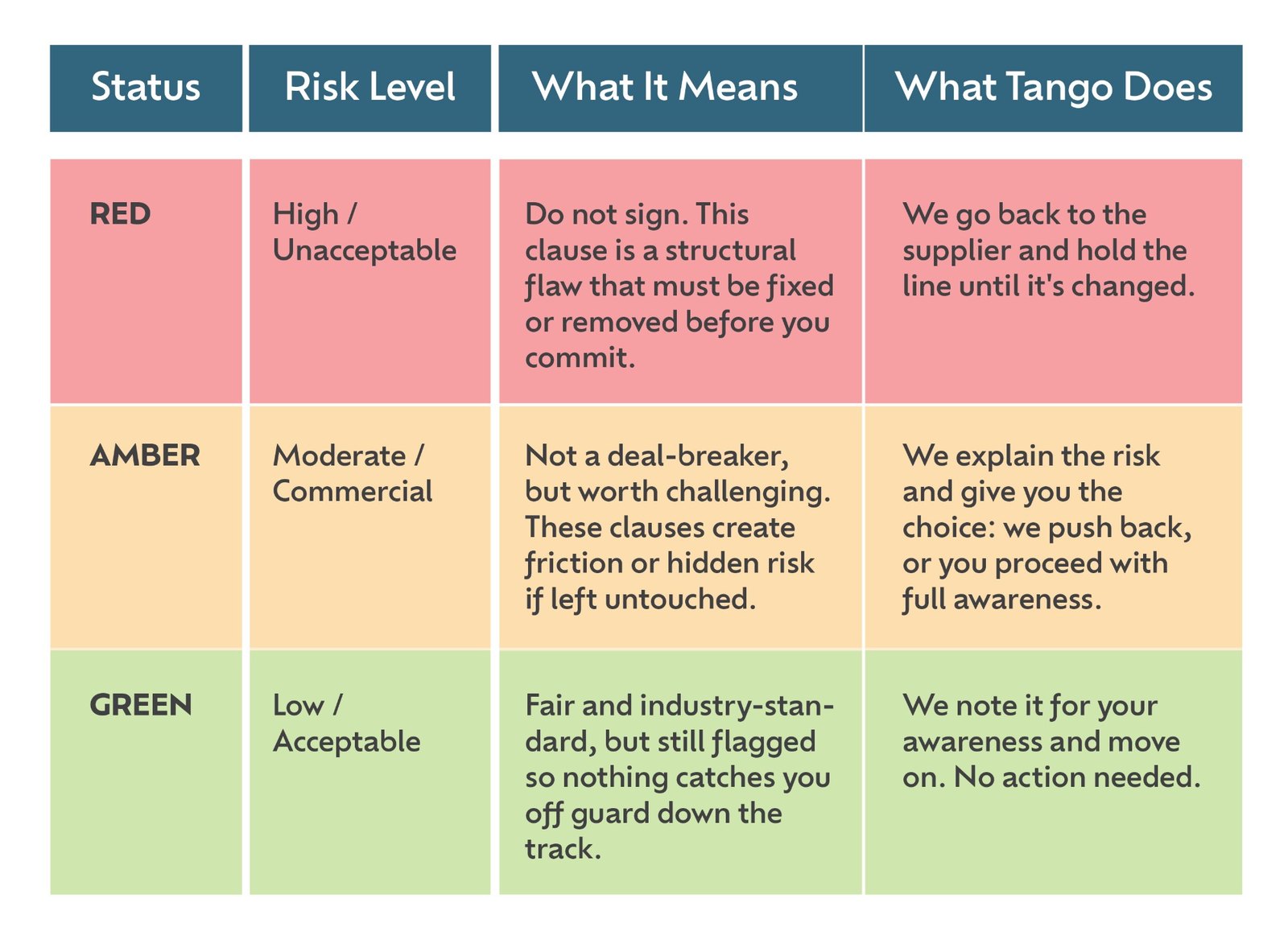
The Clauses Most Businesses Never Question
Every contract is different, but certain types of clauses appear with striking consistency and consistently disadvantage the buyer when left unchallenged.
Limitation of Liability
Picture a project that fails six months in. Data has been lost, operations are disrupted, and your team has spent months on an implementation that never delivered. You turn to the contract expecting recourse, and find a clause limiting the supplier’s total liability to whatever you paid them in the last twelve months. The cost of the failure to your business is irrelevant. The clause is standard in most vendor contracts, and most buyers sign it without realising what they have agreed to.
The Auto-Renewal Trap
Many software contracts renew automatically unless the customer provides written notice well in advance, often 90 to 120 days before the anniversary date. Miss that window, and the contract rolls over for another full term, regardless of whether the software still serves your needs. It is one of the most common and most avoidable costs in IT procurement, and it catches well-run organisations regularly simply because no one was tracking the date.
Data Rights and the AI Question
With the rapid rise of AI, software vendors are increasingly inserting clauses granting them the right to use your data to train their machine learning models. The language is typically broad and buried. Accepting it without scrutiny means handing over sensitive business information to be used in ways you never knowingly agreed to.
Jurisdiction: The Wrong State’s Rules
A Sydney-based supplier will naturally write their contracts under NSW law. If you operate in Western Australia, this matters considerably more than most organisations realise. Contract law differs between Australian states, particularly around how disputes are managed and how liability is apportioned. In WA, both parties can apply for adjudication when a payment dispute arises. In NSW and Victoria, only the claiming party can. That single difference can dramatically reshape your options if a project goes sideways.
When a Supplier Says the Contract Is Non-Negotiable
Standard contracts are, by definition, starting points. They reflect the vendor’s default risk position and standard commercial terms. They are not a final offer. What ‘non-negotiable’ most often means in practice is that the vendor’s sales team does not want to open a lengthy legal negotiation, not that the contract itself cannot move.
Most vendors simply default to standard terms unless someone raises a specific, well-reasoned objection. When you can point to a clause and explain precisely why it creates a problem in your operational context, most suppliers will find a reasonable way to address it. The conversation needs to be had by someone who knows the language. Industry data suggests SaaS agreements are successfully negotiated in approximately 70% of cases when the buyer approaches the conversation with the right knowledge and a clearly articulated position.
“We had one supplier tell our client the contract was non-negotiable. We said: you have a second alternative supplier. Use that as leverage. Ask them: do you really not want this business, just for the sake of a few fair and reasonable changes? They came back and said yes. They changed it.” — Mark Birkinshaw, Tango
Why AI Cannot Be Your Contract Reviewer
As AI tools become more accessible, there is growing temptation to run a contract through ChatGPT, accept the summary, and move on. It feels efficient, but it is far riskier than it looks.
Researchers at Stanford University tested leading AI models on specific legal queries and found they fabricated legal facts between 69% and 88% of the time. When asked about a court’s core ruling, the AI produced incorrect information at least 75% of the time. The outputs look authoritative, grammatically sound, and specific. That is precisely what makes them dangerous. The real-world consequences have already played out in courts globally, with attorneys sanctioned and publicly censured for submitting briefs citing cases and statutes that simply do not exist.
Beyond the accuracy problem, AI has no operational context. It cannot compare your SOW against your RFP response, tell you whether a dispute resolution clause is appropriate for a WA-based organisation under an NSW-governed contract, or sit across the table from a vendor and make the case for why a clause needs to change. Contract law in Australia also varies by state, and AI tools are particularly unreliable on localised, state-specific legal nuances, which is precisely where the consequences of getting it wrong tend to be most severe.
Before You Sign
Ask yourself honestly:
- Does the Statement of Work reflect everything the supplier committed to during the tender process?
- Is the SOW legally incorporated into the contract?
- Have the T&Cs been reviewed by someone who understands both the legal language and your commercial context?
- Does the governing law clause reflect the state where you actually operate?
- Are there any clauses that would leave you with no meaningful recourse if the supplier fails to deliver?
Tango’s contract review service is one of the most cost-effective steps you can take before a significant technology investment. It does not take long, and in the vast majority of cases, the suppliers change what needs to be changed because when someone who knows the steps is in the room, it’s easier to move with symmetry.
